Saved on this phone or computer only. Nothing is sent anywhere.
- Decide how you'll start
- Set a budget with a buffer
- Make it official
- Write a one-page plan
- Know your hourly number
- Buy the gear
- Get insured before the first lawn
- Tell everyone you're open
- Learn to quote before you quote
- Mow like you've done it for years
- Run the week
- Get found and keep learning
How to use this. Read a lesson, do the "do this today" bit, tick it off. Don't read all twelve in one sitting and do nothing. One lesson done beats twelve read.
Decide how you'll start
A lawn care business is a business. You can't stumble into a good one. Set it up properly and you skip years of the trial and error I went through.
The good news is the income repeats. One sale can be a weekly job for ten years. I know operators who've had the same customer for over a decade. And the grass keeps growing in a recession, so you're an ocean liner, not a dinghy.
If you've got a full-time job, keep it for now. Pick up a lawn or two after work. Then a few on Saturdays. When the job starts getting in the way of the mowing, that's your sign to go full time. You'll have savings from the extra income, you'll know the idea works, and your partner will be a lot happier about it.
Do this today
- Decide: side hustle first, or straight in full time.
- Write down what you need to earn each week to cover your living costs. You'll use it in lesson 5.
- Join the free community and ask one question you're stuck on.
Set a budget with a buffer
Savings or finance, you need to know what this is going to cost before you spend a dollar. List every start-up cost. Then add 25% on top.
That buffer is the difference between a bad week and a dead business. Most start-ups get into trouble because something breaks when they're already stretched and there's no money left to get through it.
If you can't mow all year where you live, winter needs its own plan. Either put money aside through the season or line up winter work like snow removal or Christmas lights.
Do this today
- Write every start-up cost on one page: vehicle, gear, insurance, signwriting, cards, first month of fuel.
- Add 25% to the total. That's your real number.
- Decide where winter money comes from.
Make it official
Name it first. I can't move forward on a new business until it has a name. Keep it simple, say what you do in it, and make it easy to spell and search for.
Check with your council or city hall whether you need a business licence. While you're there, check the noise bylaws. That tells you how early you can start on a full day.
Open a separate business bank account. Every dollar from the business goes in. Once a week you take your drawings out. Never treat it as a personal piggy bank. If someone ever makes a claim against you and can show you mixed the money, you can lose your personal assets even with a company structure.
Sole trader is fine to start. You can change to a company later when there's something worth protecting. Ask your accountant when you get one, and check the local tax rules.
Do this today
- Pick the name. Search it on Google and Facebook first to make sure nobody local has it.
- Open the business bank account.
- Check licence rules and noise start times for your area.
Write a one-page plan
You don't need a 20-page business plan. You need answers to four questions.
What image? Upmarket, mid-market, or budget. Upmarket pays well but the truck is always clean and the branding has to look bigger than you are. Mid-market is the easiest to aim for and makes good money. Don't go budget. It's more work for less money, and once you've built a cheap brand you can't climb out of it.
What services? Start with mowing plus anything you can add without buying gear, like gardening. Think hard before spending real money on a second service. Scattered force lacks direction.

What target market? Small to medium domestic, large lawns, or commercial. Your gear has to match. A big mower that won't fit through the gate costs you money on small lawns, and a small mower on a big job gets you underpaid. If you go commercial, budget for more paperwork, more insurance, and customers who pay in the third month. You'll need three to four months of cash.
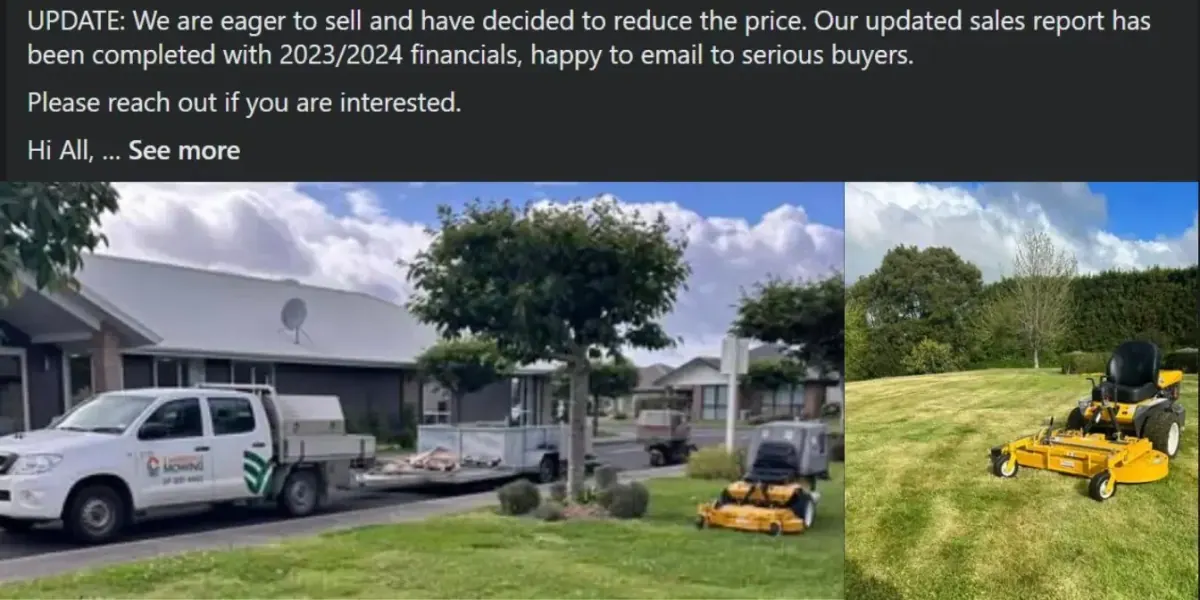
What's the exit? Start with the end in mind. I've seen plenty of guys walk away from a business at sixty that they could have sold for tens of thousands. When I sold my first business I didn't have surnames for half the customers and some addresses were wrong. The buyer mowed the wrong yard. Keep a proper customer list from day one: full name, correct address, phone, notes.
Then write one, two, five and ten year goals. Half an hour, no more. Comparing them to what actually happened each year is where the value is.
Do this today
- Pick your image and your niche. Write both on one line.
- Write your four goals.
- Start the customer spreadsheet now, even with zero customers in it.
Know your hourly number
Accounting is dry. Learn the basics anyway. Not to do your own books, but so you understand your accountant and can tell if they're any good. Business owners have lost thousands because they couldn't read their own numbers.
Use software from day one. Xero is good. Zoho has a free version.
Here's the one calculation that matters. Take what you need to live on for a year. Add your personal tax. Add 50% of that total for running costs. That's the turnover you need.
- $50,000 to live on
- $10,000 personal tax
- $25,000 running costs (50% of $60,000)
- $85,000 turnover needed
$85,000 over 52 weeks is $1,634 a week. Over 40 hours that's $40.86 an hour. Below that number you're going backwards. Everything you quote from now on sits on top of it.
Pay yourself about 50% of turnover through the year. After year end and taxes, whatever's left is your bonus.
Get paid on the day. When I get home I text every customer I mowed: "Hi, Stuart here from Gecko Lawns. Your lawn was cut today. Please deposit payment in (account details) today. Thanks." If nothing shows after three days, one reminder text. That second text nearly always works.
Do this today
- Work out your hourly number with the sum above, or use the lawn price calculator.
- Sign up for accounting software.
- Save the two payment texts on your phone, with your business name in them.
Buy the gear
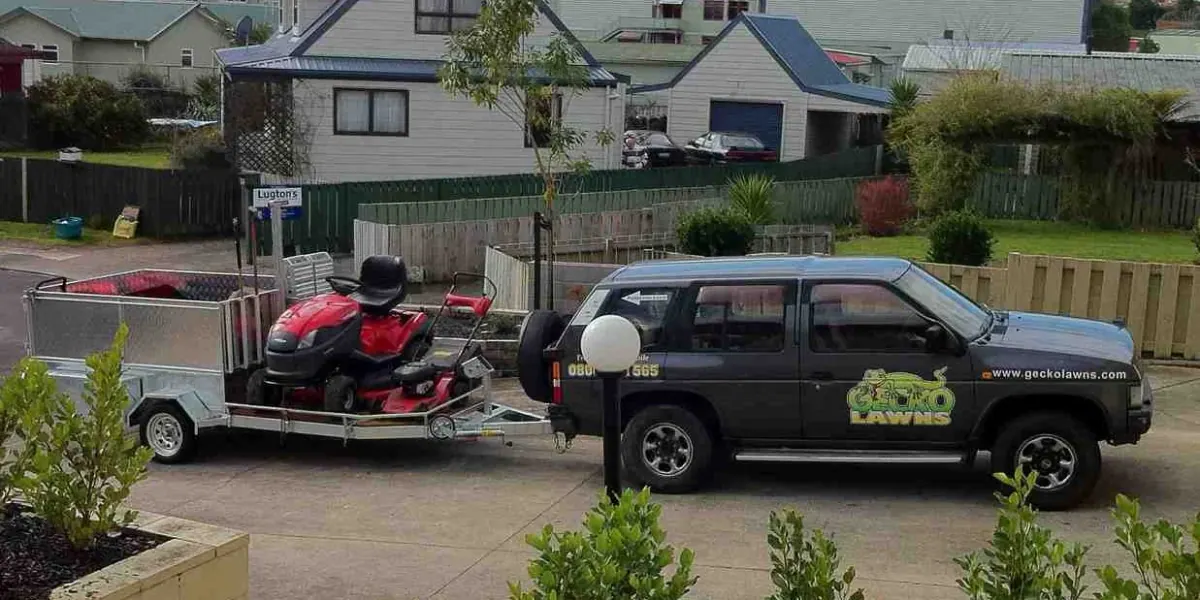
Vehicle first. A pickup, a van, or a car with a tow bar. Sort it early because it becomes the bottleneck. A guy in my area started out of a station wagon with a mower and trimmer in the back, picked up nine accounts in his first week, and bought a van that weekend.
Tidy and low miles beats flash. If you have to start with a wreck, park it on the street when you quote and don't leave oil on the driveway. Then plan to upgrade as soon as you can.
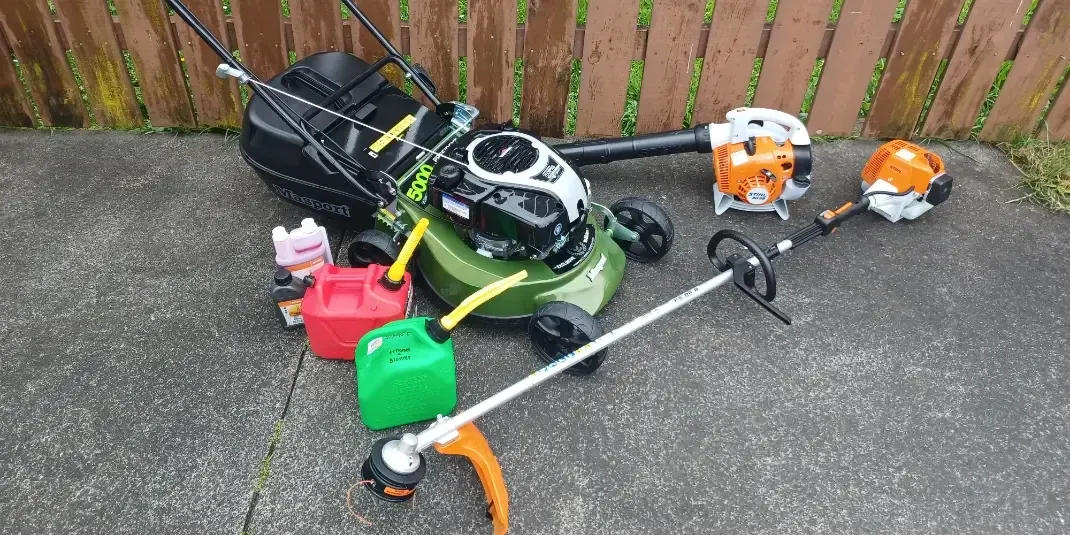
For the gear itself, start with high-end domestic. Three things:
- A mower, around $1,200
- A straight-shaft line trimmer, around $650
- A blower, around $500
You don't need the latest and greatest. You do need it to start every morning. Don't buy second-hand unless you can fix it yourself.
Buy from a local shop that does same-day repairs, and pay their bill on time, every time. That one habit is why my shop drops everything when I walk in with a breakdown.
Do this today
- Sort the vehicle, even if it's the one you already own.
- Buy the mower, trimmer and blower.
- Pick your repair shop and open an account.
Get insured before the first lawn
Public liability first. You'll probably never use it. But if a stone goes through a window, or worse, it's the one thing between you and losing your house. It's not expensive. 1 to 3 million is normal. Some commercial contracts want more. A private hospital I work for wants 10 million, but that's rare.
Vehicle: at least third party. If you hit an expensive car you could be paying it off forever. And ring your insurer if you're using your personal car. Some policies stop covering you the day you signwrite it or use it for work.
Gear: my rule is only insure items worth over $1,000 when the excess is $500. Cheaper stuff I carry the risk on.
Do this today
- Get a public liability quote.
- Ring your vehicle insurer and tell them it's for business now.
- Decide what gear you insure and what you self-insure.
Tell everyone you're open
Start with your own circle. Family, mates, the people at work, the neighbours. Tell them you're looking for lawns.
Order business cards, get the vehicle signwritten, and get a shirt with your name on it. You need to look the part to be taken seriously.
Set up a Google Business Profile. It's free and it puts you on the map when someone searches "lawn mowing near me". Set up a Facebook page. Drop flyers in the streets you want to work in.
Talk to businesses that don't compete with you. A gardener who doesn't mow. An arborist. The mower repair shop, where you can leave flyers and offer to mow while the customer's mower is being fixed.
Then the bit everyone gets wrong. Answer the phone. Let it go to voicemail and you lose two-thirds of your leads. Answer politely and fast and you're ahead of most of the industry without spending a cent.
Do this today
- Set up your Google Business Profile.
- Tell 20 people you're mowing lawns. Message them, don't wait to bump into them.
- Order cards and a shirt.
- Make sure the phone rings loud, on the mower and off it.
Learn to quote before you quote
Quoting is Goldilocks. Too high and you lose every job. Too cheap and you win every job and make a rod for your own back. You need the sweet spot, and the only way to find it is to know what's being charged locally.
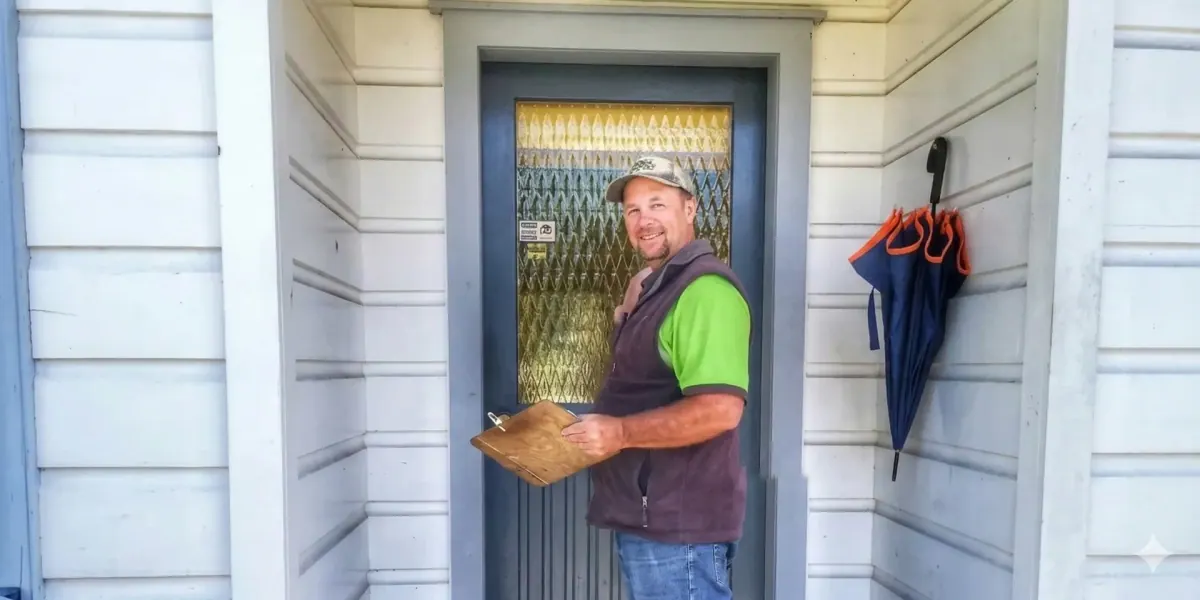
So do this. Ring a local lawn care business every day for ten days and ask for a quote on your own lawn. Start with the biggest ad and work down. Take notes. How did they answer? What did they ask? What did they quote? Who didn't turn up? Did they offer extras? Did they follow up?
You won't enjoy it. Do it anyway. Those ten calls will pay you back for years.
You don't need contracts. I've never used one, and I've sold hundreds of accounts without them. A verbal "weekly or fortnightly, and you can stop whenever you like" is easier to say yes to, and a signature wouldn't stop them leaving anyway.
Do this today
- Make the first of your ten calls.
- Set your minimum price for a lawn. Don't go below it.
- Practise one full quote on a mate's lawn, out loud, start to finish.
Mow like you've done it for years
Park out of the way. Never block a driveway, and never a shared one.
Trimmer first. Tilt it to 45 degrees and go around the property anticlockwise. Touch every edge once. Throw the grass onto the grass, not the concrete. If clippings are landing on the path you're going the wrong way round.
Mowing: if you're mulching, go clockwise around the lawn so the clumps on the right side get cut twice. If you're catching, mow out to the far end and work back toward the trailer so the full catcher has the short walk.
Change direction so the lawn doesn't rut, without keeping notes. My system: 1st to 9th of the month in circles, 10th to 19th up and down, 20th to the end across.
Cut at two to two and a half inches. Customers will ask for lower because they think it grows back slower. It doesn't, and it wrecks the lawn.
Never mow without doing the edges. Someone asks for "just the mow, no trimming" to save money. Don't take it. Everyone who drives past sees your name on a half-done job.
Do this today
- Do your own lawn exactly this way. Time it.
- Write your direction-by-date system on a note in the truck.
Run the week
Plan your days against the traffic. If everyone drives into town in the morning, mow a couple of lawns near home first and head in when the road clears. Start early where the noise rules allow. Commercial lawns can go first.
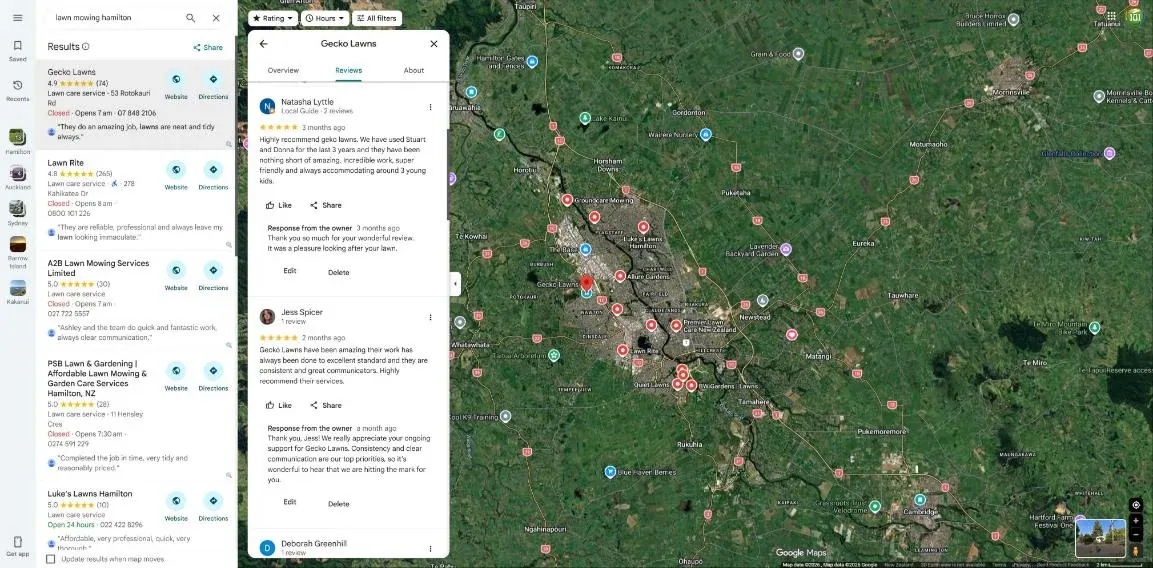
Ask for a Google review after every one-off job that went well. Reviews are what push you up the map, and most lawn businesses never ask. Pick a night each week and text last week's customers your review link.
Look after the gear. I put a small hour meter on every push mower and service them every 33 mower hours. Air filter every 150 hours, and write the hours on the new filter. Carry spare spark plugs. When something won't start, nine times out of ten it's the plug. I took gear to the shop for years before I noticed the first thing they did was swap the plug.
Do this today
- Plan your first route on a map, against the traffic.
- Copy your Google review link and save it in a note.
- Buy two spare spark plugs and an hour meter.
Get found and keep learning
Here's what happens once you're going. A homeowner hears your name, picks up their phone and Googles you. If they find a proper website with your number on it, they call. If they find nothing, or a half-finished page, they call the next guy. You never find out it happened.
A website and a Google profile with reviews is the whole online side of a small lawn business. You don't need more than that. You do need that.
And never stop learning. Listen to podcasts and audiobooks on the mower. Read a small business book a year. Lawn and Landscape magazine is free. Learn a new service like lawn treatments once the mowing is steady. The operators who keep growing themselves are the ones still in business in ten years.
Do this today
- Google your own business name. What comes up is what your customers see.
- Run the legit score to see what's missing.
- Post your first win in the free community. Even one lawn counts.
What owners say about my training
Lawnmowing 101, is a must for anyone that is looking to start up a lawn mowing business from scratch. Even if you have a lawn mowing business, you should still consider gaining more knowledge from this course.
Tons of knowledge and value learned from both Stuart and Donna. They provide great support, especially if you are new to the business. Very highly recommended.
Lawnmowing 101 is really helpful to anyone that is clueless on how to go about running a mowing business. There are many useful courses and tips that I wish I knew about before I started out that would’ve saved me lots of future headaches.
Want the website done for you?
I build lawn care websites first, free. You see it live before you pay a cent. Keep it and it's $59 USD a month, Google profile included.
Got a question about any lesson? Ask it in the free community. I'm in there most days.