Who is this post written for?
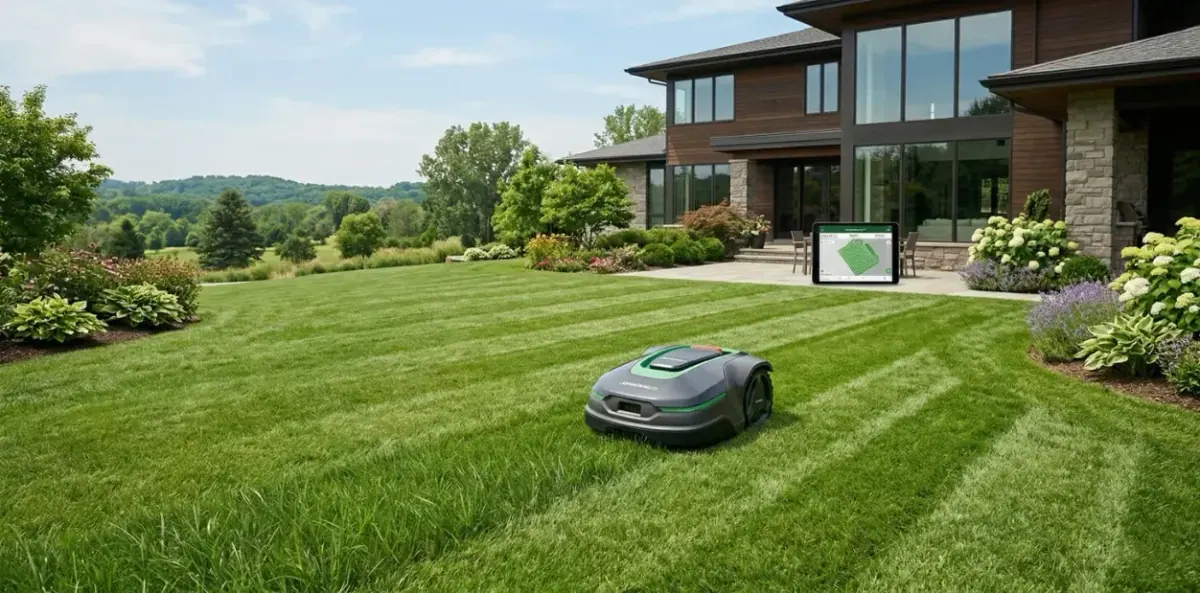
We will be looking at using a robotic mower for home use as well as lawn care business operators. I will discuss the pros and cons for each in this article.
As a lawn care business owner, I have noticed that robotic mowers have become more common over the last few years. In the past, the only real downsides were the setup cost and the nightmare of burying boundary wires. However, as of 2026, those barriers have mostly vanished.
We all know that electricity is environmentally friendly, and we get the warm fuzzies when thinking about doing our bit to save the planet, but there have been a couple of good reasons not to go battery-powered. At least on a commercial basis anyway.
The two main reasons for a slow commercial uptake were the high initial cost and the time-consuming setup. Today, robotic mowers are designed to run without an operator, and with the new “wire-free” technology, they are becoming a lot more attractive to the lawn care industry. The price has finally dropped to a point where it makes sense for a professional fleet.
Seeing this has made me start looking at the possible uses of robotic mowers in domestic or commercial situations.
How long has the robot lawn mower been around?
Robotic mowers have been around since 1995. The first robotic mower on the market was made by Husqvarna and is called the solar mower. It was electric, automated, and solar.
Today, they have docking stations and much more efficient batteries. When they get low, they simply head back home to recharge and then head back out to finish the job exactly where they left off. While they’ve been popular in Europe for years, they have officially taken over the American market now that they don’t require buried wires.
Pros and Cons of Using a Robotic Mower?
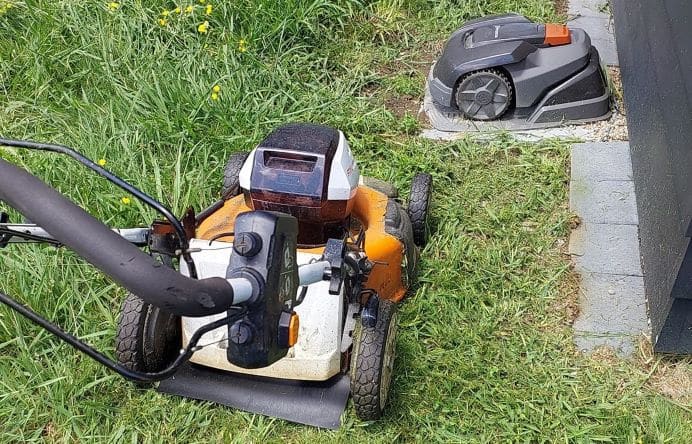
A modern robotic mower is a small mulch mower that, in the past, moved in a random pattern. However, most 2026 models now use systematic mowing. This means they mow in perfect straight lines, just like you would with a push mower. It does not need to catch the grass because it will trim the grass a little at a time on a regular basis. Doing this means that you will not get visible grass clippings left, and it will keep your lawn tidy. It will quietly work away at around 55-65 dB, and you will be able to have your mower work whenever you want—even in the middle of the night.
How a robotic lawnmower can benefit your lawn
In theory, you should get a better-quality lawn with a robotic lawnmower, as they will do a lot of things that your domestic or commercial mower will not. Some of the major benefits are listed below:
- Perfect Stripes – Unlike the older models that wandered around randomly, new systematic mowers can give you that classic striped or even a diamond pattern. Because the mower is guided by high-precision GPS (RTK) or LiDAR, it can create patterns that would take a human hours to get right.
- No soil compaction – A traditional mower weighs a lot more than a robot mower, so it tends to compress the soil over time. This means that it can need aeration every now and then to keep it in good condition. Grass does not grow as well in compressed soil. If you use a robotic lawn mower, it greatly reduces the need to aerate a lawn.
- Diseases – As a robotic mower is constantly traveling around, all parts of the lawn are mowed on a regular basis. This greatly reduces the chances of diseases, as the lawn is healthy and in optimum growing condition.
- Mulching – This is extremely healthy for a lawn but not always practical with a weekly service. Using a robotic mower gives a light cut daily. The fine bits of mulch this produces will fall back into the lawn, therefore feeding it and promoting healthy growth.
- Weeds – A lawn cut daily at a set height discourages weeds, as this is not a good environment for them.
Giving instructions to your robotic mower using an App
You can use a smartphone app to control everything. The biggest change lately is virtual mapping. Instead of burying a wire, you now just “drive” the mower around the edge of your lawn using the app like a remote-control car to set the boundaries.
There are quite a few things you can adjust with the app, but the main ones are:
- Creating Virtual Boundaries (No wires needed!)
- Adjusting the cutting height
- Modifying or changing the Schedule
- Setting “Stay-out zones” (like for a temporary flower bed)
- Sending your mower back to base.
How much does a robotic lawn mower cost?
When robotic mowers first came onto the market, they were quite expensive. Prices have crashed recently, making them a very practical option for homeowners and lawn care companies alike.
The highest-quality robotic mowers for a standard yard now range in price from $600 to $2,500. You can get a very capable “wire-free” entry-level mower for under $900 today. This makes it a much easier pill to swallow than the $4,000 price tags we saw a few years ago.
If you were to pay someone to mow your lawn with a conventional mower around 20 times a year at $45 per visit (prices have gone up!), you would be spending around $900 a year. A robot mower can now pay for itself in a single season.
How to set up a robotic mower
In the old days, you had to bury a boundary wire. While some cheaper or older models still use this, most new machines use RTK-GPS or LiDAR. Instead of spending 6 hours on your hands and knees with a spade, setup now involves placing a small antenna in your yard and then using your phone to map the area. It usually takes about 20 to 30 minutes. Once it’s mapped, the mower knows exactly where the lawn ends and the flower beds begin.
Common Questions Asked Before Buying a Robot Mower:
What size lawn can I mow? Entry-level machines at around $900 will now easily handle up to 0.125 to 0.25 of an acre (about 5,000 to 10,000 sq ft). The top-of-the-line commercial machines can handle several acres, and if you have a massive property, you can simply run two or three robots at the same time.
Flat lawns and sloping lawns Standard robotic mowers handle a 20-degree slope easily, but the newer all-wheel drive (AWD) models are monsters. Some of them can now handle up to an 80% slope (about 38 degrees), which is actually steeper than a human can safely mow with a push mower.
How long does the battery last? Most modern mowers will run for two to four hours before heading back to the charging station. The batteries are much better now (lithium-ion is standard), and they usually last 3 to 5 years before needing a replacement.
The cons of a robotic mower
- Edging – While they are getting better, most robots still leave a small strip (about an inch or two) against walls or high fences. You’ll still need your line trimmer for a perfect finish, but “cut-to-edge” tech is quickly fixing this.
- Visual Obstacles – In the past, toys and sticks were a huge problem. However, many 2026 models now have AI Vision cameras. They can actually “see” a toy, a garden hose, or even dog poop and will steer around it instead of chewing it up.
- Leaves and Fruit – If a tree does a big dump of leaves or fruit overnight, you’ll still want to clear that. While the mower won’t break, it’s not good for the blades to be hitting apples or thick piles of wet leaves all day.
How secure are robotic mowers?
Security has come a long way. Most mowers now have built-in GPS tracking and 4G connectivity. If someone picks up your mower, it will send an alert to your phone and show you exactly where it is on a map. Plus, they are pin-coded, so they are basically useless to a thief.
The advantages and disadvantages of using a robotic mower in your lawn care business?
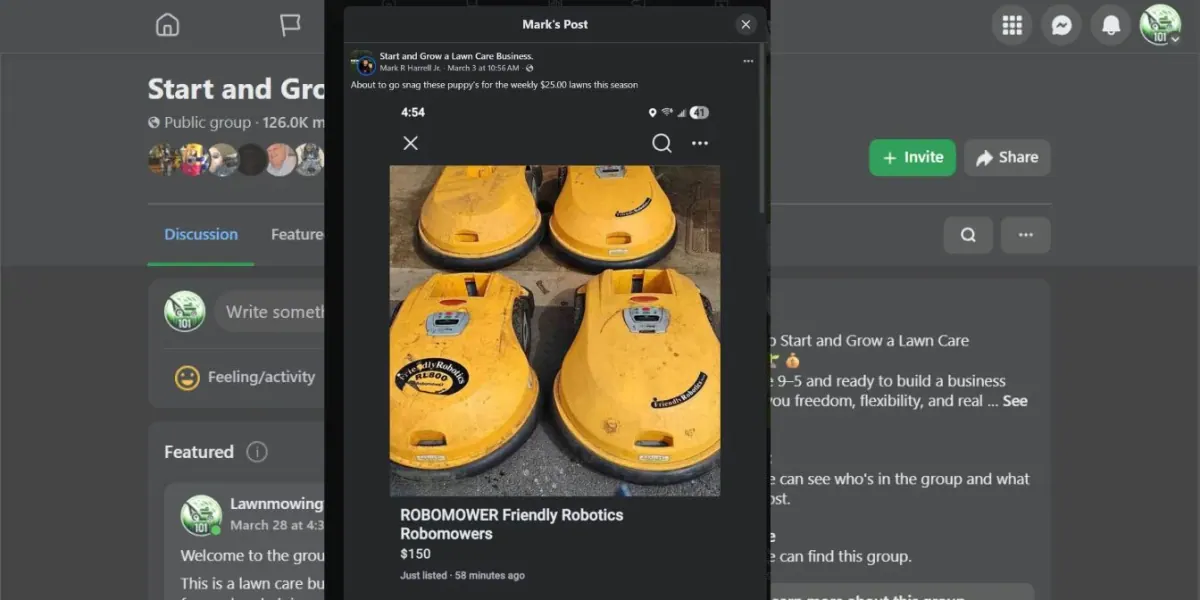
This is where things have changed the most. I used to say the price needed to drop below $1,000 to make this viable—and it finally has.
For a lawn care operator, the “drop and mow” model is now a reality. You can arrive at a site, set the robot off to do the main flats, and while it’s working, you can do the high-value work like hedging, detailed trimming, or chemical applications.
Some of the advantages now are the following:
- Labor Shortage Solution: It’s harder than ever to find good workers. A robot doesn’t call in sick.
- Fleet Management: You can track 20 mowers across the city from one dashboard on your phone.
- Lower Overhead: No gas, fewer oil changes, and lower transport costs.
A note on the industry: Some of the early startups like Robin Autopilot and Mowbot have changed hands or shifted focus as the big manufacturers (Husqvarna, Segway, and Mammotion) have caught up. Another company I mentioned before, Electric Sheep Robotics, was acquired by Oso Electric Equipment in late 2025, showing that the “big players” are now fully invested in this AI tech.
Now, would you let one of these loose on your lawn?
There could be one coming to a lawn near you real soon.

34 years mowing lawns. Built it up to five vans and 450 contracts, then cut back to a 20-hour week on the best lawns. My story.
Want more lawns?
I build lawn care websites first, free. You see it live before you pay a cent.