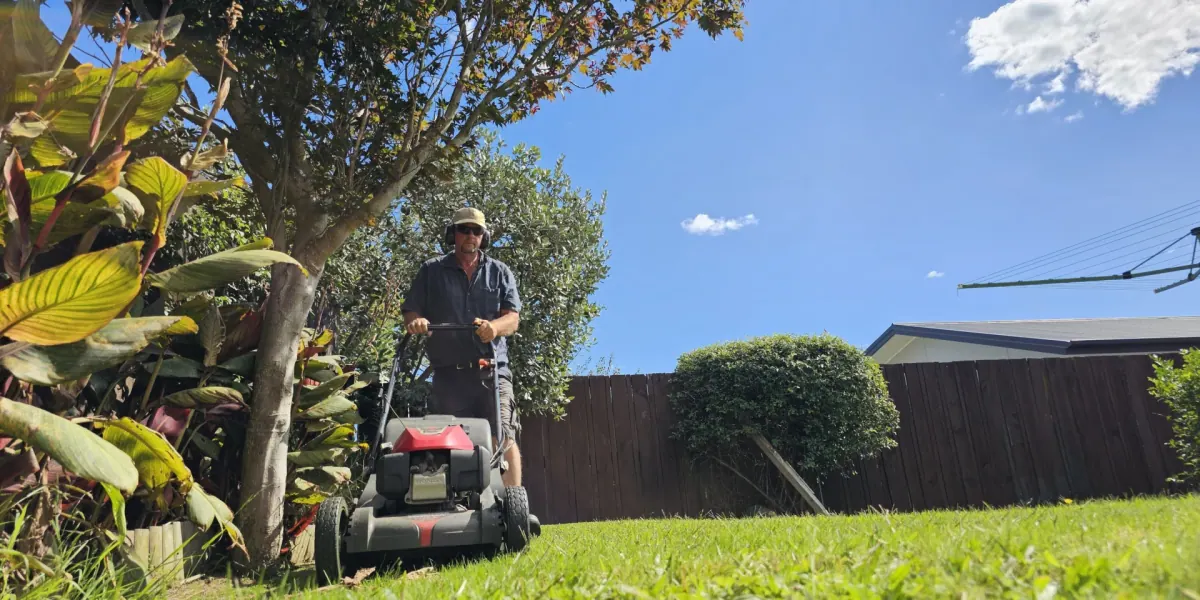
What are the best things to look for in a mower?
Let’s find out…
When I bought my first self-propelled lawn mower, I got it wrong. I walked into a shop and bought a machine that looked ok and ticked a few boxes. (and no, one of them was not price.)
This turned out to be a bad idea, and the machine constantly broke down. It was a rear-wheel drive, and it seemed like I was getting the drive fixed every other week.
One of the biggest issues with self-propelled mowers is that if the drive stops working, then you can’t finish the job, so you need to make sure that the machine you buy is reliable. By the time you pack everything up, drive to the repair shop, get the mower fixed, and drive back to the job, you have lost half a day.
Within six months I had given up, and I got rid of that mower and wrote it off as a bad investment and a very expensive one at that.
I am writing this so you can avoid going down this road. Do a little bit of research and at least walk in with your eyes wide open.
In this post, I’m going to cover all the things that I should have checked before I bought that first self-propelled mower.
This is not so much a “what is the best mower?” post but a post about “what are the best things to look for in a mower?”
So grab your lawn-mowing hat, and let’s embark on this exciting journey together towards finding your ideal mower!
Key Takeaways
- When choosing a commercial self-propelled lawn mower, consider factors like front or rear-wheel drive, engine power, speed control, deck material, bag quality, and wide-cut options.
- Some top picks for the best commercial self-propelled lawn mowers in 2026 include the Exmark Commercial 21 X-Series, the Toro TimeMaster 30-inch, and the EGO Power+ Commercial Line for operators transitioning to battery power. Additionally, with Honda exiting the gas mower market, the STIHL RM 453 V has become a highly recommended ‘prosumer’ alternative for those starting a new lawn care business.
- These mowers offer features like high-powered engines; large rear wheels for easy maneuvering on uneven terrain or hills (rear-wheel drive); variable speed control for flexibility and precision while mowing (front-wheel drive); durable deck materials (steel or aluminum); high-quality bags for effective grass collection; and wide cutting widths to cover more ground efficiently.
The 30-inch Toro TimeMaster, powered by a Briggs & Stratton 223cc engine, is considered the best large walk-behind lawn mower with 10 ft-lbs of torque, but my personal choice would be the Honda HRN 216VKA, which is ranked as the best overall self-propelled lawn mower for 2023.
I am currently using a self-propelled Honda HRX217VKA, and it does fantastic mulching lawnmowing and offers excellent cut quality and turf maintenance. I especially like the lever that can be adjusted to give anything from a full mulch to a full catch.
The Husqvarna W520 is a commercial-grade walk-behind lawn mower with a 179cc Kawasaki engine and aluminum casing, and the Toro TimeMaster 21199 is a top choice for gas-powered self-propelled lawn mowers, offering fast and clean lawn cutting.
Top three mowers for 2026
These are the most commonly bought mowers at the moment. It doesn’t make them the best, but it should help with your search.
1. Exmark Commercial 21 X-Series (Best Overall Commercial Gas Mower)
- Why it’s a top pick today: Exmark is still considered the gold standard for commercial push mowers. For a solo operator starting out, the Commercial 21 X-Series is an absolute tank.
- Key Features: It features a ¼-inch thick die-cast aluminum deck that won’t rust and can take a beating on a landscaping trailer. Even though Honda stopped making their own mowers, Exmark still offers models with commercial Honda GXV160 or Kawasaki engines.
- Business Benefit: It gives you an infinitely variable drive speed, incredible bagging efficiency, and ultimate reliability. It’s an expensive upfront investment, but it’s built to run all day, every day, preventing costly downtime.
2. Toro TimeMaster 30-inch (Best for Maximizing Efficiency)
- Why it’s a top pick today: Time is money in the lawn care business. If a business owner doesn’t have the capital (or trailer space) for a massive zero-turn rider, the 30-inch deck of the TimeMaster (or its heavy-duty sibling, the TurfMaster) is the ultimate middle ground.
- Key Features: Powered by a Briggs & Stratton 223cc engine, this mower features a dual-blade cutting system that tackles overgrowth beautifully. It features Toro’s Personal Pace system, which automatically matches your walking speed.
- Business Benefit: That extra 8 to 9 inches of cutting width compared to a standard 21-inch mower cuts mowing time down by roughly 30% to 40% on medium-to-large residential lawns, allowing you to fit more clients into a single workday.
3. EGO Power+ 21-Inch Select Cut XP / EGO Commercial Line (Best Battery-Powered Mower)
- Why it’s a top pick today: The biggest update you can make to your older post is acknowledging the shift to electric. Many neighborhoods and municipalities are putting noise and emission restrictions in place, and the EGO 56V line has become the go-to for eco-conscious lawn businesses.
- Key Features: Models like the LM2200SP or the heavy-duty LMX5300SP boast incredible specs, often pushing over 11 ft-lbs of torque—which actually outperforms standard 200 cc gas engines. They feature multi-blade cutting systems and dial-adjusted variable-speed self-propulsion.
- Business Benefit: With 10.0Ah or 12.0Ah batteries, lawn care operators are getting excellent run times. You save money on gas, oil changes, spark plugs, and carburetor cleanings, all while being able to market your new business as a “quiet” or “green” lawn care service.
Special Mention: STIHL RM 453 V (The Ultimate Honda Replacement)
Business Benefit: The mono-handlebar design is a game-changer for efficiency, giving you completely unobstructed access to the 55-liter grass catcher. Because the polymer deck is so light, it drastically reduces operator fatigue during long, multi-lawn days. It’s the perfect entry-level professional mower that balances rugged durability with ease of use.
Why it’s a top pick today: With Honda exiting the gas mower market, lawn care professionals and ambitious beginners have been looking for a reliable, high-quality replacement. The STIHL RM 453 V has stepped up to the plate, offering premium engineering at a price point that won’t bankrupt a new business.
Key Features: It features a 20-inch (51 cm) cutting width and is built around a double-layered polymer deck that is rust-proof, UV-resistant, and incredibly lightweight (around 72 lbs). It comes equipped with STIHL’s Vario wheel drive for infinitely variable speed adjustment, a 4-in-1 cutting system (catch, drop, mulch, and side-discharge), and their signature mono-comfort handlebar.
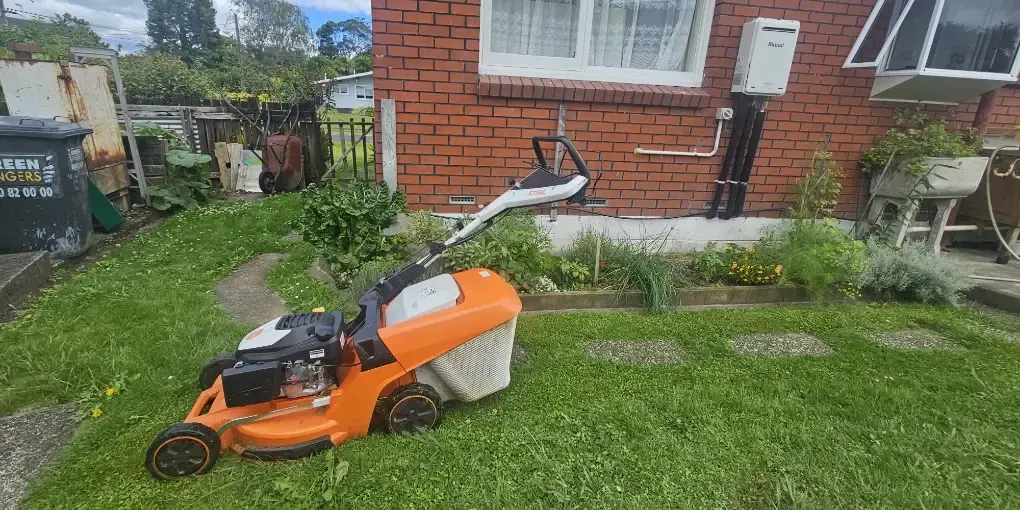
Factors to Consider When Choosing a Commercial Self-Propelled Lawn Mower
When choosing a commercial self-propelled lawn mower, there are several important factors to consider. I know that I point out three machines in this post, but it will also help you evaluate other mowers too. These are some of the first things I look at when buying a new mower.
Front or rear-wheel drive?
This is a personal choice. Front-wheel drives are usually cheaper, but I think there is a good reason for that. Although they can help with larger lawns or possibly a lawn with a lot of obstacles, a front-wheel drive will give you better steering.
However, I prefer rear-wheel drive every time. You get more control with a rear-wheel drive, and I think this is down to the center of gravity. When you have a rear-wheel-drive mower, then the weight is evenly balanced in the middle of the mower. This means that as the catcher fills up, you get better traction (not worse). If you are bagging damp grass and your catcher fills up, it can actually start making the front of the mower lift in the air. This would be a disaster if you were using a front-wheel drive, and you would be constantly losing traction.
Engine size and power
The power of a mower comes from its engine. Big engines give more power. For example, the Toro TimeMaster 21199 has a strong 223 cc Briggs & Stratton engine. This makes it good at cutting grass and working on all kinds of land. I like the Honda engines myself, and the HRX range (no longer available) comes with a great GCV200 engine that is more than enough for most mowing jobs.
Some people like electric mowers because they are quiet and kind to nature. I’m still not quite sold on the battery-powered mowers yet; I still see the guys that I know with battery-powered equipment still end up compromising with things like time in the field and the weather.
Choosing an engine with lots of power can make your job easier. You’ll get great results even on thick grass or uneven land. So, think about what you need before buying your machine!
Remember, size does matter when we talk about lawn mower engines—bigger isn’t always better!
I remember when I was doing a lot of reclaim work on overgrown lawns; I relied on my trusty Briggs & Stratton 850 series engine. It chewed through those yards. However, I don’t do that kind of work anymore, so the engine is now a bit larger than I need.
Speed control
Speed is another key factor with self-propelled mowers. It’s a funny thing, but I always feel like I could be going a bit faster, but you need to remember that the machine is mowing the lawn as well as driving the wheels. I have heard of people speeding up self-propelled mowers; however, I would not advise this, as they have a maximum speed for a reason.
Some of the more expensive models have features like speed control options and variable speed controls.
Some mowers even have cruise control, which lets you set and keep a desired speed.
So, when looking for the best commercial self-propelled lawn mower, don’t forget to check out the available speed control options!
And remember it is the speed under load you are interested in, not how fast the mower goes without the blades engaged.
Deck material
The deck of a mower is the glue that holds everything together. There are two main kinds of decks on the market and a surprise third one that you may not know about.
Steel
The great thing about steel decks is that they are stronger and can handle rough areas or uneven surfaces. One of the downsides of steel decks is that in some areas they can rust. If you live in an area with high condensation or a lot of rain, then a steel deck may not be for you.
Aluminium
The best thing about aluminum decks is that they are lighter and therefore easier to maneuver. A lot of lawn care operators in my area prefer aluminum decks, as they are less prone to rust in the wet weather we get here.
Plastic.
This third one might surprise you. I have been using machines with plastic decks for over a decade, and they are lightweight and easy to maneuver. The mower I use now, which is a Honda HRX 217, has a plastic deck; however, you wouldn’t know looking at it.
Funny story
In New Zealand, most of the contractors shy away from steel decks and gravitate towards aluminum decks. However, when I was in Perth, Australia, and talking to contractors there, they told me that they would never use aluminum bodies there. It’s steel every time for them as the sand eats away at aluminum bodies and weakens them.
Just remember that the body type should be the best for you depending on your location and the conditions you work under.
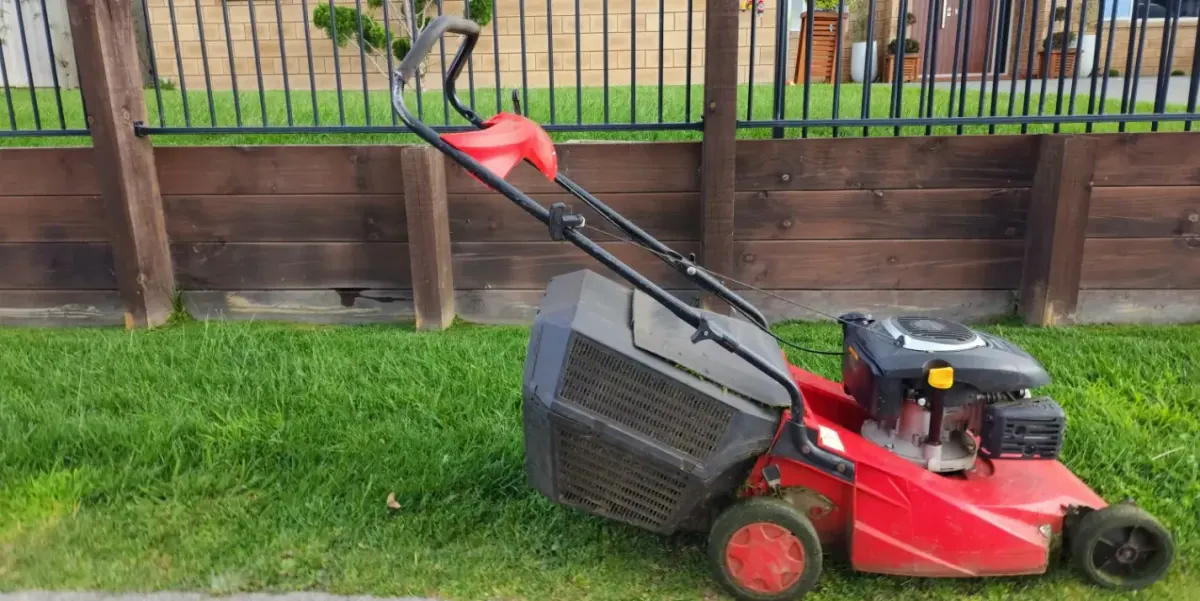
Height Control
When looking at height control, I prefer options. The fewer options you have, the more wear and tear you can expect on the height adjustment mechanism.
In the early days when I mowed lawns, there was a simple leaver that controlled the height of the complete mower.
Then the mowers started having one height adjustment on the front and on the back of the mower. I liked this a lot, as it enabled me to raise the front half a notch and get better adjustments.
Finally, on the Honda I use now, I have a height adjustment on each wheel. This is great as it totally reduces the stress on the axle and gives you full control of the height adjustment.
Most mowers cut from around 1.18 inches to 2.5 inches in height.
Bag quality
Bag quality is an important factor to consider when choosing a commercial self-propelled lawn mower. You want a bag that is durable and can handle the rigors of regular use. A good bag should be made from high-quality materials that can withstand the weight of grass clippings without tearing or ripping.
It should also have a secure attachment system to ensure that it stays in place while you mow. Additionally, a well-designed bag will have adequate capacity to hold a significant amount of clippings, reducing the need for frequent emptying.
I have had both cloth and plastic catchers. I do prefer plastic as I find it easier to keep clean. One of the big factors when you are bagging grass is airflow, and plastic catches seem to get the best airflow. The biggest issue I have with plastic catchers is that they always seem to be a bit small.
The catcher I am using now on my Honda is cloth, and it’s quite good to use. It’s a good size, and my machine double-cuts the grass, so I can get more in my catcher, and that is a bonus.
Wide-cut options
When looking at self-propelled mowers, the cut width is also an important thing to consider. The bigger the cut width, the faster you will mow the yard. However, a large cutting deck can slow you down in a small yard or a yard with a lot of things to mow around. Also, consider the size of the gates. The larger the mower, the fewer places it will fit.
We specialize in small lawns in built-up areas, so a 20-inch is the largest I want to go. However, you can find machines up to 30 inches around if you look.
Bag, mulch, and side-throw mowers.
Another thing to consider is the options available with the mower. Unless we have a specialist lawn care business, we all like cutting options. The more the better, I say.
It’s much easier to carry around a mower that does both rather than dedicated mulch and bag mowers.
Some mowers have mulch plugs. I hate them; they are annoying to carry around and usually get chewed up by the mower at some stage. This is where the Honda HRX excels, as it has a mulch lever. Full left is bag, and full right is mulch; they even have a few settings in between.
Conclusion
As you might have figured, this is not a comprehensive review of one machine against another (I didn’t even mention a battery-powered mower) as these things are always changing. Models come and go. Today we are talking mostly about gas mowers, but tomorrow it may be time to talk about the coming of age of the electric mower.
This post covers the things you should always be looking for in a good self-propelled walk-behind mower, whether you are purchasing your first mower from Home Depot or you are a seasoned veteran and you prefer to buy from dealers.
What you are looking for is a good machine with a powerful engine that will be able to tackle tall grass and large yards without any issues. I know that I have my personal preference, and this is because of the business model I work with. I find that for what I want, the Hondas are the best lawn mowers for the smaller yards we mow, which can have tight spaces that you would not get a larger mower through.
If your business model is larger yards and more open spaces, then the best self-propelled lawn mower for you could be a 30-inch-plus machine. When it comes to choosing a machine, there is a wide range to choose from for commercial use if you are looking at wide-area mowers.
The perfect lawn mower for you will be the one that ticks most of your boxes. Just remember that unlike me with my first self-propelled mower, you should tick the main boxes first, and the right mower will soon become obvious.
A couple of words of warning before I go.
Stay away from big-box shops that don’t repair mowers as well. Dealers offer a much better choice, as they usually have excellent customer service and can get you back on the road quick and smart if you have a breakdown. Buy your gear from a local dealer, and they will take care of you when you need it.
Why Buying Lawn Mowing Equipment Locally Is Good For Your Business
Lastly, do a bit of research before you buy. Go online and look at the model of mower you are thinking about buying and do a search for words like “clutch repair” and “gearbox repair.” You may find that the machine you are looking at has a bad history in this area. If so, you have just dodged a bullet. If I had done that with my first mower, I would have saved a lot of money and time.
However, without that story, this post probably would have been a little bit less entertaining.

34 years mowing lawns. Built it up to five vans and 450 contracts, then cut back to a 20-hour week on the best lawns. My story.
Want more lawns?
I build lawn care websites first, free. You see it live before you pay a cent.