
Should I offer other services in my lawn care business?
Hello, lawn-mowing people! Today, I want to talk about something that a lot of folks get stuck on when starting their lawn care business—what services should you actually offer?
It’s completely normal to start out wanting to offer everything. Mowing, gardening, tree work, spraying, landscaping, edging, gutter cleaning—you name it. But just because you can offer something doesn’t mean you should.
In fact, in most cases, more is not better, especially if you’re starting on a shoestring budget.
Every Service Comes at a Cost
Here’s something to keep in mind: every extra service usually means extra equipment. And sometimes, that gear ends up sitting in the shed, collecting dust—or worse, never being used at all.
I’ve been there. Bought something for a job I thought I’d do all the time, and then it turned out to be a one-off. Big waste of money. When you’re starting out, that cash could’ve gone into something that actually helped you grow your core business.
Plus, when you list every service under the sun on your flyers or website, you don’t look like a specialist—you look scattered. And trust me, that confuses potential customers more than it helps.
Start with the Basics: What You Really Want to Do
If you’re already mowing lawns, you’re off to a solid start. It’s reliable income, repeat work, and great for building a base. But before you think should I offer other services in my lawn care business and go adding in extras? I want you to ask yourself a few questions:

- Do I already have the equipment for this service?
- Do I enjoy doing it?
- Am I confident I can do it well?
- Will this help or distract from my core business?
If the answer to any of those is no—don’t add it. Just because you could do gutter clearing or chainsaw work doesn’t mean it’s worth the hassle.
Do You Need a License?
Let’s talk about licenses and insurance—because this is a spot that trips up a lot of beginners.
In most places, you don’t need a license to mow lawns. But start adding in chemical spraying, and you’re going to need a certification to legally handle pesticides or herbicides. Add hardscaping or large tree work, and there might be building codes, height restrictions, or safety training you’re expected to have.
Here’s why this matters: insurance.
If you don’t have the right license and you damage something—or worse, hurt someone—your insurance may not cover you. I know someone who killed a lawn with the wrong spray and got stuck with the bill because his public liability insurance wouldn’t cover him. Why? No chemical handling license.
And for the record, where I am, standard business insurance won’t cover you if you’re doing tree work above 3 metres. Check the fine print. Better yet, call your insurer. Get everything in writing.
If in doubt, leave it out.

Be Honest About Your Skill Level
Before saying “Should I offer other services in my lawn care business?” think about this. When I first started out, I took on a few jobs that I wasn’t fully comfortable with. And let me tell you—nine out of ten of those turned into drama.
It’s tempting to say yes to everything when you’re desperate for work. But those yeses can come back and bite you. I learned pretty quickly to stick to the stuff I knew I could do well.
Here’s a good practice: Make a list of all the services you could offer, then cross out anything that gives you anxiety. That’s your starting list.
If someone asks for a service that’s not on it? Find someone who can do it and refer them. Build a network. We do this with gardening. We hate gardening, so we don’t do it. But we’ve got someone who loves it, and they don’t mow lawns. It’s a perfect fit. We send them work; they do the same. Everybody wins.
Fewer Services = Smarter Marketing
Let’s talk about marketing for a second. If you’ve only got $150 a month to spend on advertising and you’re just pushing lawn mowing, you can get a decent number of leads.
But split that budget between lawn mowing, tree work, and gardening—and now you’ve got just $50 per service. That’s not going to move the needle on anything.
I had one guy I helped with Google Ads who had twelve different services on his website and wanted to advertise them all. That was never going to work. The budget was too spread out, the messaging was diluted, and the results were weak.

Start focused. Get good results. Then grow. That’s the formula.
Use the Chinese Saying: Start with Many, Finish with Few
There’s a great old saying: “Scattered force lacks direction.” And I agree with that 100%.
Early on, you might pick up bits and pieces of extra work just because you’re there, and that’s okay. But as your business matures, you’ll want to tighten the focus.
I started with lawns. That was my bread and butter. Then I started doing little extras—tree trimming, pressure washing, even the odd garden cleanup. Some of it paid well. But the more time I spent on one-off jobs, the more my regular income took a hit.
Now I know better. I’d rather fill a day with lawns and earn predictable money all year round than chase bigger jobs that might dry up.
How to Handle the Slow Season Without Losing Focus
There are two ways lawn care businesses usually handle winter.
The common way: chase extra jobs when mowing slows down. You do tree work, cleanups, or whatever you can get your hands on. And that’s fine—it works.
But here’s how we do it.
Instead of chasing odd jobs, we double down on lawn mowing ads. We actually ramp up our lawn advertising before spring hits. And it works. We end up with way more lawns than we need. Then, just before the busy season hits, we bundle up the extra lawns and sell them off.
It gives us a cash injection and leaves us with the best, highest-paying lawns to keep for ourselves.
This might not work for everyone, but it works great for us.
Know Your Long-Term Plan
When someone asks you, “Do you also do ___?” stop and ask yourself: “Is this helping me reach my long-term goal?”
Would you rather fill your calendar with extra jobs—or lock in a weekly mow that lasts for the next five years?
There’s no wrong answer. But you need to know what game you’re playing.
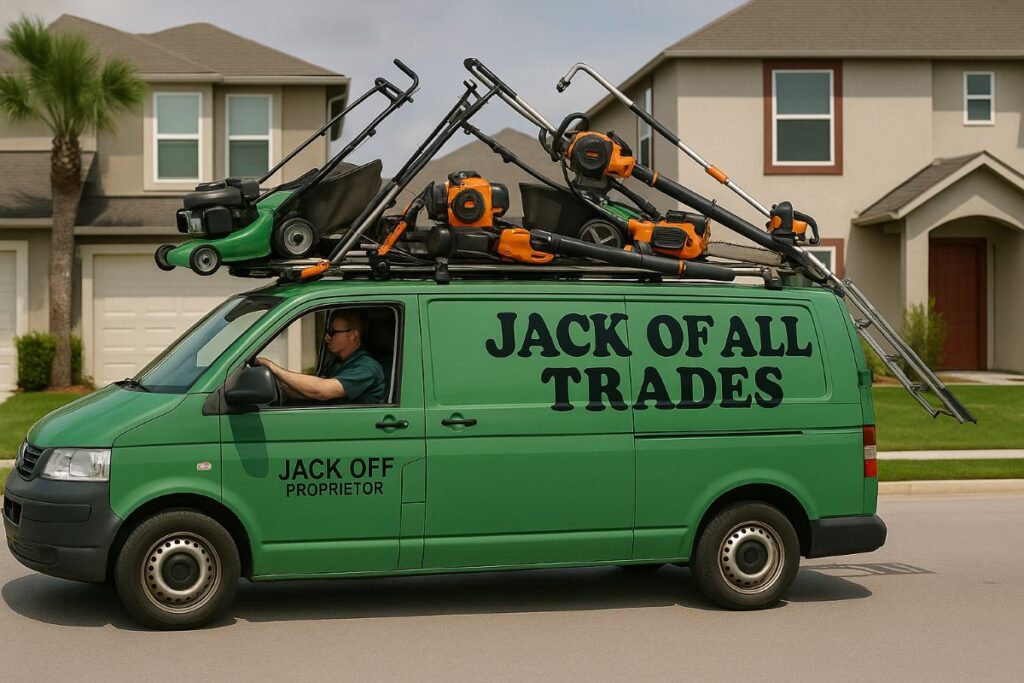
If you want to be a jack-of-all-trades, go for it. But if your goal is predictable income with less stress, it’s time to specialize.
Final Thoughts: Keep It Simple, Do It Well
Here’s the bottom line:
- Don’t offer every service just because you can.
- Start with what you enjoy and do well.
- Check your licenses and insurance.
- Build a network to refer work you don’t want.
- Focus your marketing budget.
- And always keep your long-term plan in sight.
You’ll thank yourself later.
Until next time—get out there, mow lawns, have fun, and build the business you want.
Happy mowing,