
Every February the lawn forums fill up with someone hunting for a lawn care price increase letter. “Does anyone have a price increase letter they could share? I’m writing mine up and could use some help.”
Then someone posts a template about rising economic factors and a commitment to quality, and 200 people send it to their whole round on the same day.
I have raised prices on hundreds of customers over 30 years. I have built three lawn care businesses from scratch, run 450 lawns across 5 vehicles, and I now do about 60 lawns in a 20 hour week. I have never sent a price increase letter to my whole round. Not once.
Because the letter is not the problem. Sending it to everybody at once is the problem.
Here is what I do instead. Nine things, in the order they matter, with the exact wording at number 5.
1. Do not send it to everyone
A blanket increase turns a quiet Tuesday into a week of phone calls.
Send 100 customers the same letter and you get 100 people thinking about their lawn bill on the same morning. A few of them will ring around. A few of them will find someone cheaper. And you now have to defend the same decision 100 times while you are trying to mow.

Worse, a blanket increase is almost always the wrong number. Some of your lawns are underpriced by $15. Some are fine. A flat “everyone goes up $5” leaves the bad ones still bad and annoys the good ones for nothing.
I raise one lawn a week. One. That is roughly 50 a year, so a 100 customer round cycles through in about two years, and by then the first ones are due again.
One text a week is not a campaign. It is a Tuesday.
More: Are You Charging Enough for Your Lawns? and Lawn Mowing Income: How Much Can You Make?
Do today: put a recurring reminder in your phone for Monday morning that says “one price up”.
2. Pick the lawn, not the round
Which one goes up this week? Two rules, and they never change.
The lowest paying lawn, or the one furthest from home.

The lowest paying one is obvious. It is the job dragging your hourly rate down and it has probably been sitting at the same price since you took it on.
The furthest one is the sneaky one. Travel time is unpaid time. A lawn 20 minutes out the back of your route costs you 40 minutes of driving that nobody pays for. Either it earns a premium for that, or it should not be on the round.
Here is the bit most people miss. If they say no to the increase, you have not lost your best customer. You have lost your worst one, and freed up a slot for a lawn on your existing route at your current price. That is a win either way.
More: Make Big Money Mowing Small Lawns and What Is the Best Way to Plan My Daily Lawn Care Route?
Do today: sort your customer list by price, lowest first. That top row is this week’s text.
3. Get the number from your timer, not your feelings
Never guess the new price. Time the lawn first.
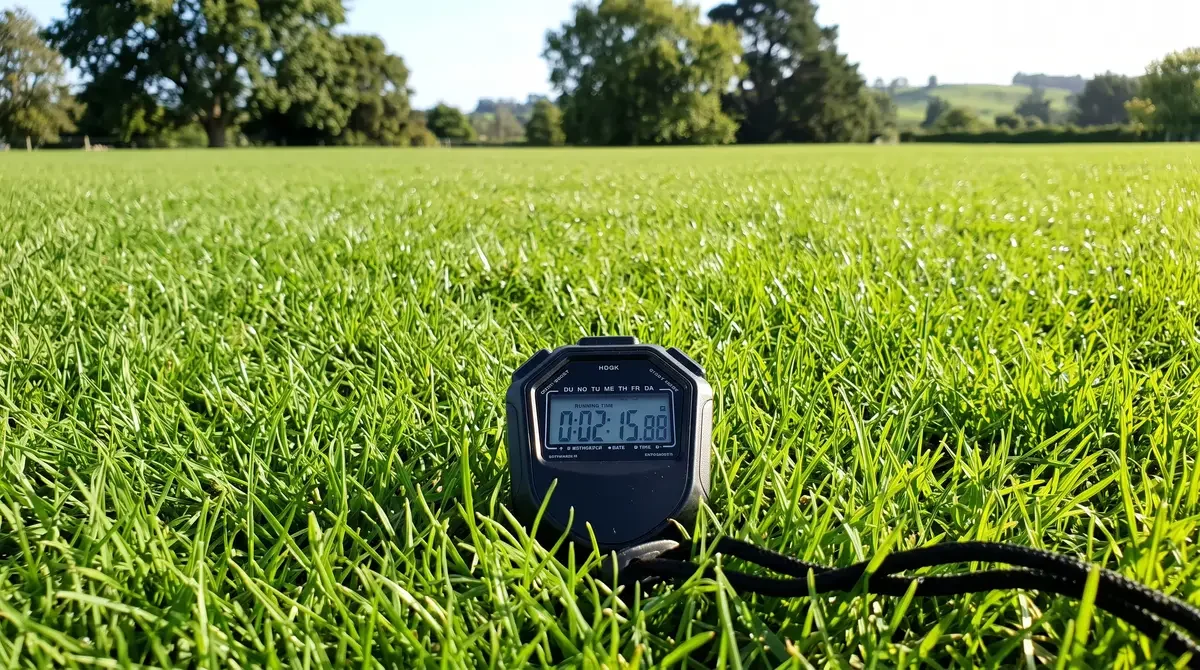
My quoting rule has not changed in 30 years. $1 per minute of estimated job time, with a minimum of $30 for a regular mow and $60 for a one off. Travel time counts.

Run a quick audit on the lawn you picked. Two real examples from my own round:
| Customer | Time taken | Price | Hourly rate |
|---|---|---|---|
| Smith | 35 min | $40 | $68/hr |
| Brown | 50 min | $30 | $36/hr |
Brown is the one that goes up. Not because Brown is a bad person, but because that lawn is paying you half what the one down the road pays.
You need about $60 an hour just to stand still once you allow for the fact that only about 6.5 hours of an 8 hour day are productive. My benchmark for a solo operator is $400 a day. If a lawn cannot get there, the price is wrong, not the customer.
Sanity check the new number with the Goldilocks test. Win every quote you send and you are too cheap. Lose four out of five and you are too dear. About one in three is right.
More: How to Quote on Lawns, The Complete Guide and Easy Ways to Make More Money by Mowing Lawns Faster
Do today: time your next three lawns door to door, including the drive, and work out the real hourly rate on each.
4. Text it, do not phone it
A phone call puts a customer on the spot. On the spot, people say no, because no is the safe answer when someone is waiting on the line.
A text gives them room to think. They read it, they grumble at the kitchen bench for ten minutes, they work out that finding a new lawn guy is a bigger hassle than $5, and they reply “no problem”. You never see the grumble.
Text also gives you a record of exactly what you said and when.
Post is fine if that is genuinely how your customers communicate, and some older customers prefer it. Email works for commercial. But for a residential round, text wins, and it is what I use.
One more thing. Say it in your own words, like a person. The corporate template about rising economic factors and our commitment to quality does not sound like the bloke who mows their lawn. It sounds like a power company.
More: How to Effectively Communicate With Your Lawn Care Customers
Do today: find the last message you sent a customer and read it back. That is the voice the increase should be written in.
5. The lawn care price increase letter I actually send
Here it is. Fill in the name, the old price, the new price and the date, and send it.
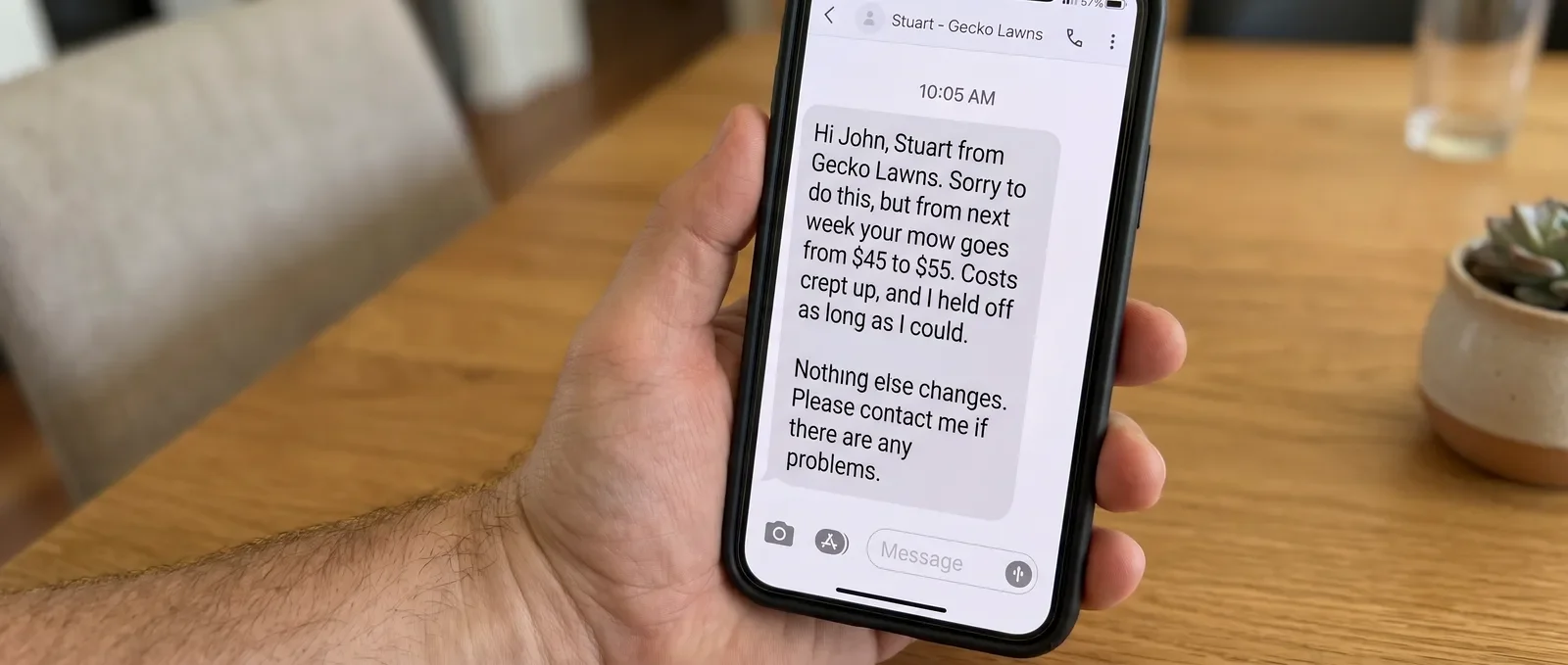
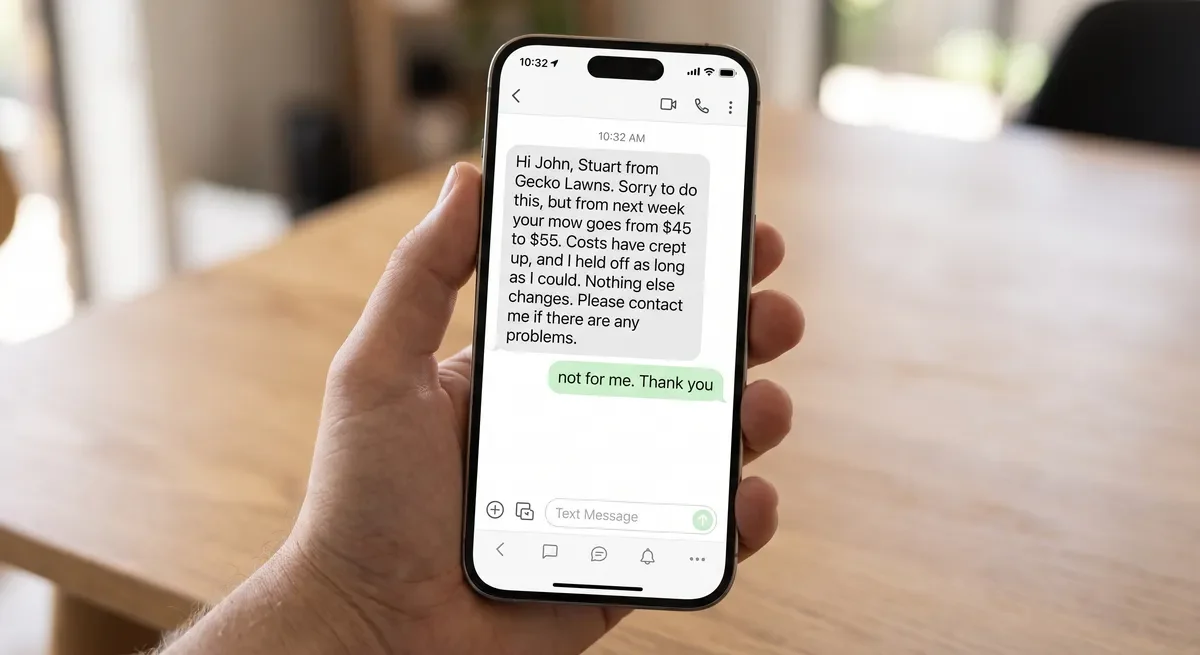
Hi [Name], Stuart from Gecko Lawns. I’m sorry to be the bearer of bad news, but from [date] your mow needs to go from $[old] to $[new].
Fuel, dump fees and gear have all crept up and I’ve held your price as long as I could. I know it’s the last thing anyone needs right now.
Nothing else changes. Same day, same job, same me.
Please contact me if there are any problems.
Shorter version, if that reads as too soft for you:
Hi [Name], Stuart from Gecko Lawns. Sorry to do this, but from [date] your mow goes from $[old] to $[new]. Costs have crept up and I held off as long as I could. Nothing else changes. Please contact me if there are any problems.
If you need a printed or emailed version for commercial or older clients, same content, just formatted:
Dear [Name],
From [date], the price for your regular mow at [address] will change from $[old] to $[new].
Fuel, dump fees and equipment costs have all risen and I have held your price as long as I could. This is the first increase on your property since [year].
Nothing else about your service changes. Same day, same job, same person doing it.
If this causes any problems, please call or text me on [number] and we will sort something out.
Thanks for your business, [Your name], [Business name]
Three things to notice about all of them.
“Nothing else changes” does the heavy lifting. The customer’s real fear is not $5. It is that something is about to get worse. Kill that fear in one line.
One reason, then stop. Fuel, dump fees, gear. Do not write four paragraphs justifying yourself. A long explanation reads like guilt, and guilt invites a negotiation.
“Please contact me if there are any problems” is deliberate. It is an open door, not a deadline. Never write “you have 30 days to respond” on a residential text. All that does is put a date in their head for cancelling.
Do today: paste one of these into your notes app with your own business name in it, so it is ready on Monday.
6. Give them a way out
This is the part everyone skips, and it is the part that keeps the customer.
Some people genuinely cannot absorb it. A pensioner on a fixed income is not haggling with you, they are telling you the truth. If your only options are pay more or leave, they leave.
So give them a third door:
I hear you [Name]. A couple of options so you’re not stuck. I can stretch you to every three weeks instead of fortnightly, which brings the yearly cost down. Or I can drop the edges and just do the mow. Have a think and let me know what suits.
Stretching the cycle is the good one. Your price per visit goes up, their annual spend goes down, and you free up capacity. Everybody gets something.
What I will not do is discount. A discount on a regular job is not a one off. You give it every single visit for the life of that job, and it compounds for years. Changing the frequency or the scope is not a discount. It is a different job at the right price.
More: What Do You Do if Someone Requests a Discount on Lawn Mowing? and Lawn Care Customer Slippage
Do today: decide now, before you send anything, what your third door is. Frequency, scope, or nothing.
7. What to say when they push back
Have these ready so you are not writing them at 9pm with your heart going.
If they say yes:
Thanks [Name], that’s really good of you. I appreciate you being understanding. See you [day] as usual.
If they say no:
That’s completely fair [Name], and I’m sorry I had to ask. I’ll keep mowing at $[old] for now and I’ll give you plenty of notice before anything changes. No hard feelings at all.
Then start replacing that slot this week. The next good lead takes it. You are not sacking them, you are just no longer protecting a job that does not pay.
If they ask for a middle number:
Let me look back at the times on your lawn and see what I can do. I’d rather find a number that works for both of us than lose you.
Come back a day later. Try to hold the new price. If you do move, move once and stop. Two moves and you have taught them that your prices are a starting bid.
If they ask why theirs and not everyone’s:
Honest answer, your lawn is one of my lowest priced and it’s been sitting at $[old] a long while. My newer jobs start at $[new]. I’m bringing yours in line rather than putting everyone up at once.
That answer works because it is true. Nobody argues with it.
If they go quiet: follow up once, gently, then take it as a yes and invoice at the new price. Most silence is agreement, not a fight.
More: How to Effectively Handle Difficult Lawn Care Customers
Do today: save all four replies in one note on your phone.
8. Timing: early in the week, never on mow day
Send it Monday or Tuesday morning. Not Friday, not the weekend, and never on the day you are due to mow their lawn.
Mow day is the worst possible timing. You turn up two hours after telling someone their price went up and now you are standing on their front lawn with the mower running while they decide how they feel about it. Give them a couple of days of distance.
Give a start date that is at least one full cycle away. If you mow fortnightly, the new price starts at the visit after next, not the next one. That is not generosity, it is just fair notice, and fair notice is what stops a price rise turning into a grievance.
Do not do it mid season if you are a seasonal operator on fixed weekly cuts. Raising a price in the middle of a season people committed to at the start is how you earn a bad reputation in a small town. Do those at the season change, with the new schedule.
More: Lawn Care Agreements with Customers: Do You Need One? and Lawn Care Cancellation Policy That Protects Your Route
Do today: pick the date. Count forward one full cycle from your next visit and use that.
9. Log it, or you will lose track
One a week for two years is 100 texts. You will not remember who is where.
Keep a simple table. Spreadsheet, notes app, back of the job book, does not matter.
| Date sent | Customer | Old price | New price | Yes / No | Replaced? |
|---|
The log does three jobs. It stops you hitting the same customer twice in a year. It tells you your real acceptance rate, which is usually far higher than you feared. And the “replaced” column makes sure the slots that said no actually get filled instead of quietly staying empty.
Track the money too. Fifty lawns going up an average of $6 is $300 a week of extra income for the same hours, the same fuel and the same wear on the mower. That is not a small thing. That is a mower a year.
More: Keeping Track of Where the Money Goes in Your Lawn Mowing Business and Are Your Customers Paying on Time?
Do today: make the six column table. Fill in row one with the customer from step 2.
The pattern behind all nine
A price increase feels enormous when you are about to send it and tiny once you have.
I once quoted $60 on a lawn and the owner told me her old guy charged $20. He had gone out of business by then. His mower broke and he could not afford to fix it. He was not undercut by a competitor. He was undercut by himself, one year at a time, because he never had the conversation I am describing here.
The customers you are terrified of losing are usually the ones who say yes in four words. The ones who blow up were leaving anyway.
And it costs five to seven times more to find a new customer than to keep one, which is exactly why you do this one lawn a week with a way out attached, rather than sending 100 letters and hoping.
The lawn care price increase letter is not the hard part. Pressing send is. Do it once this week and it gets easier every time after that.
Frequently asked questions
What should a lawn care price increase letter say?
The new price, the date it starts, one short reason, a line saying nothing else about the service changes, and an invitation to contact you if it causes a problem. Four sentences is plenty.
How much notice should I give before raising lawn care prices?
At least one full service cycle. If you mow fortnightly, start the new price at the visit after next. Seasonal operators should do it at the season change, never mid season.
How much should I raise lawn care prices by?
Whatever your timed data says, not a flat percentage. Time the lawn door to door, price it at $1 a minute with a minimum of $30 for a regular mow, and check it clears $60 an hour.
Should I email, post or text a price increase?
Text for residential, email or a printed letter for commercial and older clients. Avoid phone calls. A call forces an instant answer and the instant answer is usually no.
Will I lose customers if I raise my prices?
Some, and that is the point. Raise the lowest paying or furthest lawn first, so the ones you lose are the ones costing you money. Fill the slot with a lawn on your existing route.
Should I raise all my lawn care prices at once?
No. One lawn a week. A 100 customer round cycles through in about two years, you never face a wall of complaints, and every increase is based on that specific lawn.
Do I need to explain why prices are going up?
Give one reason and stop. Fuel, dump fees and gear is enough. Long justifications read like an apology and invite a negotiation.
What do I do if a customer refuses the price increase?
Accept it gracefully, keep mowing at the old price for now, and start replacing that slot. The next good lead takes it. Do not argue and do not sack them on the spot.
Next step
If you want the rest of the pricing system, my free group has the quoting templates, a business plan template, and a free website giveaway every month.