

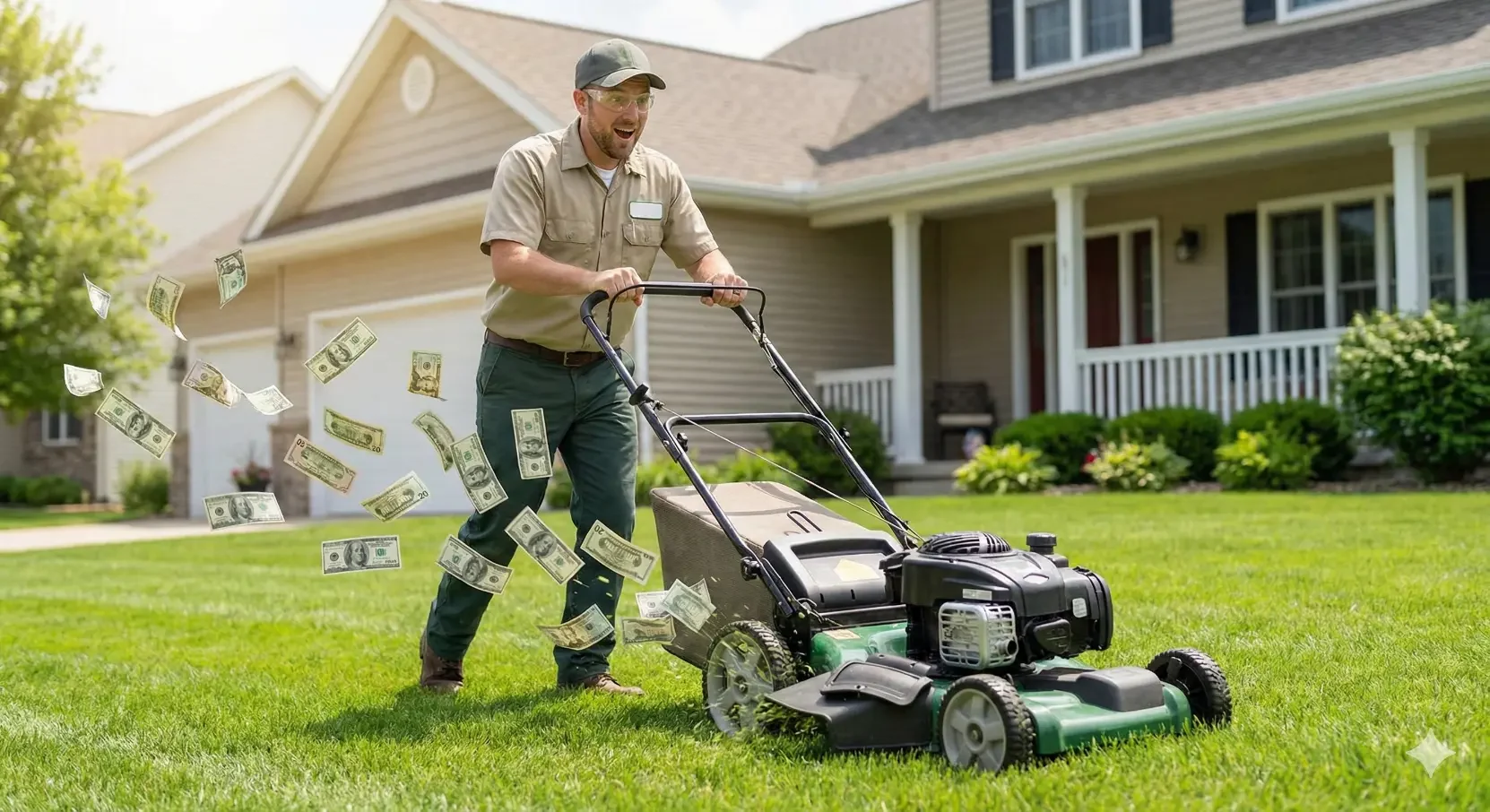
Income Potential for Lawnmowing Businesses
If you love being outdoors and taking care of lawns, then starting your own lawnmowing business may be the perfect way to make some extra income! With a little start-up capital and some elbow grease, you can soon be on your way to earning a great living while doing something you love. But how much can you really make? Keep reading to find out!
There is no set answer when it comes to how much income you can generate from a lawnmowing business. A lot will depend on the size of the lawns you are mowing, the frequency with which they need to be mowed, and the going rate in your area. However, we can give you a few ballpark figures to give you an idea of what is possible.
Most lawn-mowing contractors aim for around $60 an hour as a charge-out rate. This would mean that if you worked an 8-hour day, five days a week, you could expect to turn over $2400 a week. While this is achievable (I do more than that myself working part-time), it is not how it normally works, as there are other factors at play.
The Reality of the Hourly Rate: While $60 is the target, your efficiency determines how much of that stays in your pocket. A seasoned operator doesn’t just mow; they navigate. They understand that every minute the engine isn’t running is a minute the business isn’t making money. To hit that $2400 mark, you have to treat your schedule like a high-stakes puzzle where every piece must fit perfectly.
Other Factors That Affect Your Income
If you were to turn over $2400 a week at $60 an hour, you are going to need to be highly organized and focus on getting the work done. Things like breakdowns and quoting, debt collecting, and fueling up are all going to affect your results. Where fueling up and servicing your equipment can be done after hours, not all things can be planned and you will always lose a bit of time due to things like breakdowns, etc.
Travel Time is a Killer
If your charge-out rate is $60 an hour, then your actual turnover is more likely to be $50 an hour due to the time you are spending in the vehicle in between jobs. This will also depend on the geographic area you are working in. The further apart your lawns are, the less you will earn. If your route is compact, then you will earn more.
Another factor is the size of the lawns that you are mowing. Small lawns in a compact area would certainly pay more. I have always found that small to medium lawns work best for me, but do bear in mind that I no longer use a ride-on, so I don’t want large lawns. When I was doing ride-on work, I found that the best jobs were on large rural lawns, although I lost time due to the lawns being much further apart.
Consolidation
One way to increase your income would be to consolidate your business. What I am talking about is making your traveling area smaller. Not only will this save you money on fuel, but it will also increase your bottom line. We used to package and sell lawns on the periphery of our business every year. If you don’t want to sell them, you could simply give them up. If you replaced one of your furthest lawns with a closer lawn once a month, then you may end up traveling less, saving on fuel, and making an extra $120 a week without working any harder.

The “Density” Dividend: Think of your business in terms of “dollars per mile.” “If you are driving ten minutes between jobs, you are essentially paying for the privilege of working. By shedding the outliers and focusing on specific neighborhoods, you create a “cluster effect.” This is where you can eventually mow three or four lawns on the same street without ever loading the mower back onto the trailer. That is where the real profit lies.
How About a Pay Raise?
If you are running close to forty hours a week, then there is another option to start clicking over that magic figure of $2500 a week, and that is to increase the price. I don’t mean that you hit all of your customers at once with a price increase. If you are running a hundred customers, then you could increase the price of one job a week, and it would take you a couple of years to get through your list.
You wouldn’t even feel any of the negative effects of this because any customers that canceled would soon be replaced by the organic leads you would have coming in from time to time. Also, make sure that you are timing your lawns and price-increasing the lowest-paying lawns. You need to have actual figures to back this up. Do not go off gut feelings about which lawns need an increase. I have talked to contractors who thought a lawn was underpriced, but it wasn’t; they just didn’t like the lawn. I have also met contractors who kept an underpriced lawn because they liked it. For maximum income, you need to pay attention to your mow times.
Are You Actively Building Your Business?
If you are actively building your business, then you are going to have to allow time for quoting as well. You are not going to be able to quote when it suits you, as some people won’t wait or will go with the first person that shows up. Just yesterday I lost a quote because the phone rang while I was in the shower at home. They left a message, and by the time I rang them back, half an hour later. The job had gone. I kid you not.
If you have a smaller business and you are still doing lots of quoting, then you will probably find yourself earning less than $50 an hour. Consider that to be the cost of building your business. Once you have finished building and start bringing in $2500 a week, it will all be worth it.
The Opportunity Cost: Every phone call you miss is a potential long-term contract down the drain. While you are out there sweating over a mower, your phone is your most important tool. It’s the gatekeeper to your future income. Investing in a good hands-free setup or a dedicated time for returning calls is not just a convenience—it is a financial necessity for growth.
Running Costs
Since this article is about income and not expenditure, I won’t go into it too much here. My rule of thumb for any lawn mowing business starting off is that they retain 50% of the income in the business. This will cover other things like taxes, ACC, etc. If you run your business well and manage to keep all the other costs under 40% (which is possible), then you will be able to pay yourself a bonus of 10% of the previous year’s turnover after you have filed your yearly return.
Conclusion
As you can see, there is potential to make good money with a lawnmowing business! The key is to do your research, charge a competitive price, and provide quality service that will keep customers coming back. With a little effort, you could soon be raking in the dough!